A Place That Changed the World
There are places on Earth that do not simply exist: they produce beauty, multiply it, and hand it down to eternity. The Apuan Alps are one of those places. For millennia, from the heart of this mountain range overlooking the Tyrrhenian Sea, the most celebrated marble in the world has been extracted — that white statuary marble that has travelled through the centuries in the hands of sculptors and architects, becoming masterpieces recognised in every corner of the planet.
To speak of Carrara is to speak inevitably of Michelangelo — who came here in person to select the blocks for his works, spending entire weeks among the quarrymen. It is to speak of the Pisa Cathedral, the Paris Panthéon, the Vatican Pietà. It is to speak of a raw material that is not simply stone: it is the physical foundation of much of Western art history. And it is to speak of a territory — the Apuan coast, Versilia, Lunigiana — that still today lives, breathes and draws its identity from this millennial heritage.
To visit the Carrara marble quarries is to step physically into the place where that beauty originated. Not to observe it from a distance, not to read about it in a book: to be inside it, to breathe its white dust, to understand with your body before your mind what it means to pull from a mountain the very matter of which art history is made.
What You See and Feel at the Carrara Marble Quarries
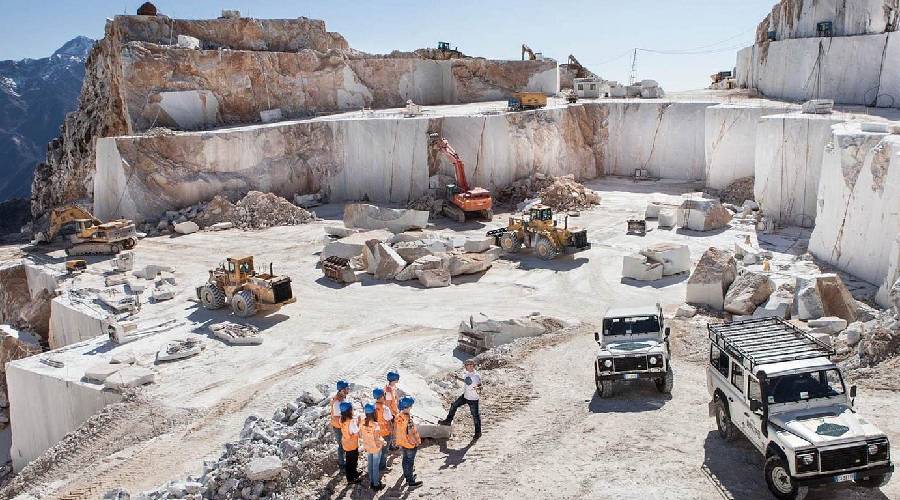
The landscape of the marble basins is unlike anything else on Earth. The white walls open up suddenly among the green of the Apuan Alps — blinding, almost surreal. Light bounces off the cut surfaces, silence is broken at intervals by the deep roar of machinery, and you have the distinct sensation of standing in a place outside of time: ancient and entirely modern at once, where man works the mountain with the same gestures as two thousand years ago, using tools that would have astonished even Michelangelo.
The Fantiscritti basin is the beating heart of this experience. This is where you board a private 4×4 Jeep to climb to 700 metres above sea level, where the active extraction faces reveal in real time how the diamond wire — no thicker than a finger, yet capable of slicing through tonnes of stone with surgical precision — separates from the mountain the very blocks that within months will become floors, sculptures and building facades across the world.
Along the road to the quarries you pass through the Ponti di Vara, monumental stone viaducts that once bore the weight of marble-laden carts, and the tunnels of the Ferrovia Marmifera, carved directly into the rock. Each gallery is a leap through time — a corridor between the industrial present and a past in which every block was brought down the mountain by sheer strength, winches and human determination.
The Ravaccione Underground Gallery: A Cathedral Inside the Mountain
There is a place within the Carrara quarries that no photograph can truly convey. The Ravaccione underground gallery is a cathedral carved into living rock: vaults soaring tens of metres overhead, walls of white marble that seem to generate their own light, a constant temperature of 15 to 16 degrees Celsius that in the heat of summer hits you like a cool, unexpected embrace.
This is not a tourist cave dressed up for spectacle. It is an authentic industrial space, still fully active, where man has hollowed out the marble to reach its core. Stepping inside changes something in the way you perceive this material: once you have seen where it truly comes from, no floor, no column, no statue will ever look quite the same again.
Access to the Ravaccione gallery is not available on standard tours. It is one of the places Viaggi di Mare can offer thanks to exclusive agreements with the extraction companies that manage the basins — a privilege that very few operators anywhere in the world can extend to their guests.
If you want to experience this in its fullest form — five hours of total immersion across the quarries, the underground gallery and the village of Colonnata — discover our Carrara marble quarries full immersion tour.
Colonnata: Where the Mountain Becomes Flavour
Every great landscape has its own food culture. And the landscape of the Carrara quarries has Colonnata — the oldest village in the marble basins, perched at over 500 metres above sea level between white stone walls, reachable only along a narrow mountain road that is itself worth the drive.
Colonnata is the birthplace of Lardo di Colonnata IGP, one of the most extraordinary and least known food products in all of Italy. It is not simply cured pork fat: it is a delicacy aged for months in locally quarried marble basins, with sea salt, rosemary, garlic, black pepper and spices that vary from family to family and from season to season. Here too, marble is not merely stone: it is an instrument of preservation, transformation and flavour.
The stop in Colonnata brings the day full circle in the most natural way imaginable. You arrive from the white mountain, you enter the quarrymen’s village, and you sit down to eat something that exists only here — something that cannot be replicated anywhere else in the world. It is the moment you realise that the Carrara marble quarries are not simply a landscape: they are a civilisation. With its history, its labour, its beauty and its taste.
Who Is This Tour For
There is a quiet thread connecting everyone who chooses to spend a day at the Carrara marble quarries with Viaggi di Mare: curiosity. Not the superficial kind that wants to tick an attraction off a list, but the deeper kind that searches in travel for something that stays — a memory, a feeling, a new way of seeing the world.
It is the right tour for families who want to give their children something both educational and genuinely exciting: the 4×4 Jeep climbing the mountain, white walls rising towards the sky, a guide explaining how a sculpture is born from raw rock. It is the kind of day that stays with young people far longer than any museum visit ever could.
A perfect choice for groups of friends travelling along the Tuscan or Ligurian coast who want something beyond the beach — something to talk about for years, to share and laugh about together while riding a Jeep at altitude with the Apuan Alps all around. Something that ends with remarkable wine and lardo in a village that feels untouched by time.
A genuinely memorable way to mark a birthday, an anniversary or any occasion worth celebrating: a private, exclusive, unrepeatable experience that feels like a real gift rather than a last-minute booking. The kind of thing people remember not just for what they saw, but for how it made them feel.
And the right choice, finally, for travellers with a passion for art, history and food who want to read a territory in its full depth — not just the view, but the hands that have shaped it for centuries, the flavours it has produced, the works that left from here to become some of the most admired objects in human history.
Art, Memory and Wonder: Why This Journey Stays With You
Some travel experiences accumulate without leaving a mark. Others change something in the way you see the world — or at least a part of it. Visiting the Carrara marble quarries belongs to the second kind: not because it has been designed to impress, but because it is real, ancient, and larger than anything you anticipate.
The scale of an industrial landscape unlike any other on Earth. The history of art encountered in the very places where that history found its material origin. The privilege of entering spaces normally closed to the public. The physical pleasure of authentic food eaten in the exact context where it was born. All of this in a single day, with an expert guide, in a private vehicle, with no more than six people around you.
If you are planning a trip to Tuscany or the Ligurian Riviera, this is the day you will carry home longest. Not the beach, not the dinner table: the moment you walked inside the mountain where the Pietà began.
Four hours or five — choose what suits you:
- Private Carrara Marble Quarries Tour — 4 hours: choose between a 4×4 Jeep tour through the open-air quarry or exclusive access to the Ravaccione underground gallery (closed quarry). Includes expert guide, marble museum visit and tasting in Colonnata.
- Carrara Marble Quarries Full Immersion Tour — 5 hours: the complete experience, combining both — the 4×4 Jeep tour through the open-air quarry and exclusive access to the Ravaccione underground gallery. Includes expert guide, marble museum visit and tasting in Colonnata.
Your Questions About Visiting the Carrara Marble Quarries, Answered
What is the difference between the 4-hour and the 5-hour tour?
Both tours include Mercedes transfer, an expert guide, a marble museum visit and the Colonnata tasting. The difference lies in the quarry experience. On the 4-hour tour you choose between two options: the 4×4 Jeep tour through the open-air quarry — reaching the active extraction faces at high altitude — or exclusive access to the Ravaccione underground gallery (closed quarry). On the 5-hour full immersion tour you get both: the open quarry by Jeep first, then the underground gallery. It is the tour for those who do not want to choose — and do not want to miss anything.
Are the marble quarries accessible for everyone?
Yes. Both the Mercedes minivan and the 4×4 Jeep make the experience accessible even for guests with limited mobility. The guide adjusts the pace to suit all participants. No particular physical fitness is required, and the tour works well for families with children and senior travellers alike.
Where does the tour depart from?
We offer private pick-up directly from your hotel along the Apuan coast, in Forte dei Marmi and Pietrasanta. Departure from La Spezia is available with a supplement. Drop-off is always at the original pick-up point — no logistics to manage on your end.
How many people are on each tour?
No more than 6 guests per group. Every tour is strictly private: no shared coaches, no strangers, no compromise on pace. Just your group, your guide and the experience.
What is included in the Colonnata tasting?
The tasting features Lardo di Colonnata IGP, fried sgabei from the Lunigiana tradition, local cheeses and regional wine. Vegetarian and gluten-free alternatives are available on request — just let us know when you book.